Monday, July 1, 2013


LET THE DEAD
BURY THEIR DEAD

INTRODUCTION

The title of my homily for this 13th Monday in Ordinary Time is, “Let The Dead Bury Their Dead.”

In yesterday’s gospel, we had Luke’s version of this same saying and scene we have in today’s gospel from Matthew.

At least 5 people - if not 7 people - made comments to me about this text. That means they heard it. Some thought it was too tough. Some wondered why it was okay in yesterday’s first reading for Elisha to go home and kiss his parents goodbye and then come follow Elijah - and then Jesus seems to be saying the opposite.

On Saturday morning, one of the men of the parish who visits our jail on Jennifer Road read the readings for yesterday with some of the Catholic prisoners and what hit a few of the men was,  “Jesus is too harsh!”

I read several commentators on the text and most say they are not sure just what Jesus was saying, other than saying, “Stop putting excuses in the way of following me. Drop everything and start following me - and start living and proclaiming the kingdom.”

It could also be a local saying - or everyday proverb - that everyone would get. You don’t have to be knitting of sewing - for someone who is putting off going to the doctor - or fixing a leak in their house - to hear, “A stitch in time saves nine.”

It doesn’t have to be raining - for someone to hear the saying when they are having lots of troubles, “It’s raining cats and dogs.”

MARRIAGE AND FAMILY

I noticed in marriage preparation literature - folks talking about not letting one’s family get in the way of one’s marriage.

Couples might mess up their relationship - when one is spending all their time with their parents or sister or brother - to the neglect of one’s own spouse.

Couples with children - better not neglect each other - by not noticing the other - just the kids.

Balance, awareness, communication - along with dedication are called for.

A DEATH IN THE FAMILY

A woman once said to me that she had a choice when her husband died - to jump into the grave with him - and pull the grass over her - or mourn, cry, and get moving again.

Any of you who have had a long sickness in the family - know how draining that can be.

This week - 150 years ago - 11,000 died at Gettysburg. I have to read Lincoln’s Gettysburg Address again with today’s gospel in mind.

Being a priest - I’m aware how much closeness to one’s family - especially when a parent is sick - is a factor. It’s also difficult when one is far from home. It adds to the difficulty factor when one is an only child. Being a priest one hears the stress and the anger at times when one person in the family feels they are doing everything for an aging parent and the other brothers and sisters are doing nothing.

It’s often not simple - but very complex.

Of course it is human to bury one’s parents and mourn one’s dead. Hey Jesus said in the Beatitudes, “Blessed are they who mourn, for they will be comforted.”

So when Jesus says something tough - like “Let the dead bury their dead”  - we need to know there are other sayings of Jesus to look at.

CONCLUSION


When Jesus died - there was Joseph of Arimathea and Nicodemus - asking and showing up to bury him. Most of his disciples were buried - as if dead - in the Upper Room. So Jesus had someone to bury him. Then the women went to the tomb - so the gospels are very aware of the human need to bury the dead - and hang around tombstones. [Cf. John 19: 38 to 20: 29]

We have to balance all that with the need to not get buried by death - but to come to live with Resurrection and hope - for living life to the full now and in the hereafter - not in some tomb.


PLANNING


Quote for Today - July 1, 2013


"Humans plan. God laughs."

Anonymous Jewish Saying

Sunday, June 30, 2013

THE FURIES


INTRODUCTION

The title of my homily is, “The Furies.”  F  U  R  I  E  S. “The Furies.”

I don’t think it’s a normal term we use - but my hope is that as a result of this homily - we will to say to ourselves - and maybe at times to those we’re very close to, “Right now I have a case of The Furies.”

Translation: I’m furious. I’m discombobulated. I’m all shook up. I’m antsy and I’m angry. I’m in a “Uh oh!” situation and state. So I just want you to know that. Okay?  Could you give me some time and give me some space. Let me do some walking right now?”  

“Okay!”

We hope the other will step back and say, “Okay!”

CONSUMED

I noticed in today’s gospel and today’s second reading the word, “consumed” and I was going to make that the title of my homily.

I also noticed in today’s first reading that Elisha - the future prophet - before setting off to follow and take Elijah the prophet’s place,  - he  slaughters his 12 oxen, burns the wooden yoke harness as fire wood to cook the oxen - and then feeds his people with the meat. It must have been an enormous cook out.

I prayed, “Come Holy Spirit  - Divine Fire - Inspire me to come up with a theme to preach on that will help and feed us this week.”

I focused on the English word, “consume.” Next I checked out in my Greek New Testament - the original language of these New Testament writings - what Greek word does that word “consume” translate.  I found out it’s “analisko.” I noticed that the same Greek word is used in both today’s gospel from Luke and today’s Letter to the Galatians from Paul.  It literally means what burns us up, what destroys us, what eats us up, what consumes us. What “analiskos-es” us. It’s a negative term - more than a positive one.

So that’s where the title and theme of my homily comes from: The Furies - as in “furious” - or “fiery” -  or “What burns us up?” or “What’s consuming us?”  - or even “What’s destroying us?”

THE FURIES

Psychology didn’t just start in the late 1800’s and early 1900’s.

To be human is to have fire, passion, emotions, drives, energies - the Furies.  This has always been part of people - down through the ages. We get emotional about religion and politics, taxes and someone jumps into a taxi ahead of us, sports and relationships - and the neighbor who is learning how to play the piano or drums.

All the religions, the great playwrights, philosophers, deal with our inner life - our hearts and minds - our feelings - out thinkings  - what makes us tick - what gives us life and what destroys us.

We’ll all pot belly stoves - consuming something - making that fire go and grow and glow - stoking it and feeding it - winter, summer, spring and fall.

What are we throwing in our fire?  What’s giving us energy? What’s making us angry? What’s make us joyful? What are our desires? What are our fires? What do we get hot and bothered about?


 The Greeks - as well as the Romans - talked about The Furies - the 3 Furies. It’s interesting that they saw them as feminine - the 3 sisters: Allecto, Tisiphone and Magaera - Anger, Vengeance and Jealousy.

It’s an ancient way of understanding inside stuff - inside stories - the inner life. It’s a way of looking at anger and vengeance and jealousy. If we do wrong - there will be a price to pay. Guilt - and get back - will always try to get us back. There is always punishment. There is always pay back as we play back our sins - and selfishness - our me me isms. The scales of justice - being held by a blindfolded woman statue - stands not just in court houses - but inside the court house of our brain. It  is a reality. Rich, poor, old, young, all people regardless of who we are - have to deal with consequences - and aftermath - and the aftereffects of injustice - when we haven’t played fair.

Life tries to balance itself out.


 Fortunately, the Greeks and Romans also talked about the 3 Graces. They are also feminine, They are the 3 sisters: Beauty, Charm and Goodness.

So what’s the state of our soul?  What’s in our bottom drawer? What’s in our closet? What’s cooking - what’s burning in our pot belly stove? What are our 3 main furies and our 3 main saving graces?

TODAY’S GOSPEL

Joy to the world: Christ has come. We don’t have to journey alone.

Christ and being a member of his body can be our Saving Grace.

In today’s gospel,  Jesus and his disciples are heading for Jerusalem. Jesus is heading for his destiny in Jerusalem - to face the big boys - to face ultimate evil - which he does on the cross.

On the way - as we heard in today’s gospel - they stop in a Samaritan village.  They are snubbed. They are not welcomed. They are looked down upon. There’s not one good Samaritan in their midst.

James and John become furious and they want Jesus to burn down the town. And by the way, their nicknames were “Boanerges” - which some translate as “Sons of Thunder” and others as “All bark, no Bite.” So they could be hot heads - or noisy complainers.

Jesus calms them down and he practices what he preaches and they head for another town. Luke doesn’t say that they shook the dust off their feet of that town, but that’s what Jesus preached. Move on. Move on.

Walk away from trouble - anger. Don’t just count to 10. Take a thousand steps away from wanting to scream at someone or punch them out.

Years ago I remember asking a fire chief in New York City what the number one cause of fires in New York City was. His quick - without hesitation - answer was: cheating on another man’s wife or woman. The hurt man torches the other man’s apartment or house.

TODAY’S SECOND READING

In today’s second reading from Galatians, Paul challenges his listeners to look at one’s life and ask if we are living by the Spirit or by the Flesh. It’s our choice.

I was wondering - but I’m not sure - if I could see the two Greek choices of living by The Furies or by The Graces - in this context of Paul’s contrast: Flesh vs. Spirit.  Maybe. Maybe not.

I better stick with Paul and say we can live by the Spirit or we can live each day by the Flesh.

One brings freedom; the other brings slavery.

It’s our choice.

If we live by the Flesh - we bite and devour one another - and Paul says beware - be aware  - this can consume us. The desires of the flesh can do that.

Greed, envy, griping, always gratifying our flesh - can grind us down - and empty us.

Paul tells the Galatians - and us - Christ has set us free - if we love our neighbor as ourselves - if we live by the Spirit - we can have the yoke of slavery removed from us - and we can be set free. When this happens, we don’t need any laws.  The Holy Spirit  will guide us.

That’s vintage St. Paul.

CONCLUSIONS

So that’s my homily. When we have a case of the furies, it’s good to be aware -  we have the choice to live by the Spirit or the Flesh. We have the power of choice. We can choose to be graceful or furious.

We are like a furnace or a pot belly stove. We can feed the fire - with good stuff - to be passionate about loving one another and making this a better world and family  and work space and neighborhood to be alive in or we can be slaves to our passions - our furies - and end up being burnt out and nasty, ugly people.


In the meanwhile as we heard in today’s gospel, Jesus calls us to bury our skeletons - skip the excuses - put our hands to the plow - stop looking backwards - and be part of his dream of proclaiming and making his Kingdom come here and hereafter. Amen.
RELIGION


Quote for June 30, 2013


"Let your religion be less of a theory and more of a love affair."

G.K. Chesterton [1874-1938]

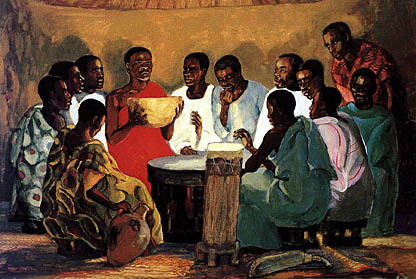
Painting on top: Last supper painting from the Mafa People in Cameroon

Saturday, June 29, 2013

DISLIKES OF YOU 

Quote for Today - June 29, 2013


"We often dislike a person not for what he or she is, but for what we are."

Anonymous

Friday, June 28, 2013

PREACHING


Quote for Today - June 28, 2013

"Most preaching is answering questions people are not asking."

Anonymous


2 Questions:


How does the preacher know what questions people are asking?

Do people know what questions they are asking - and if they do how to they get them to the preacher?


Picture: In case you were asking, the above is a posed preaching picture from around 1968 in the big pulpit at my first assignment as a priest: Most Holy Redeemer Church, East 3rd Street, Manhattan, East Village, New York City.

Thursday, June 27, 2013


PERPETUAL HELP

Could anyone offer us perpetual help?

Moms try - but they have to escape
every once and a while - offering  
a 3 year old a bribe or some logic -
for some time -  but most of the time
these tricks don’t work. Kids cling. 
Kids know. Kids don't like to be alone.
Kids keep knocking on bathroom doors.

They want their mom to be there all the time.

So moms whether they know it or not,
have kids who think their moms
are wearing a label,
“Our Mother of Perpetual Help!”

Ooops. I forgot to say: “Today, June 27
is the Feast of Our Mother of Perpetual Help.”
Check out the picture. It’s any kid running
to his mom for help! - especially when
they see scary crosses and crucifixions
in their future. Mom you better be there!


© Andy Costello, Reflections 2013
MAKING MISTAKES

Quote for Today - June  28, 2013 


“Experience enables us to recognize a mistake every time we repeat it.” 

Anonymous

Wednesday, June 26, 2013

GRATITUDE

Quote for Today - June 26, 2013


"An ungrateful person is like a hog under a tree eating acorns, but never looking up to see where they came from."

Anonymous

Tuesday, June 25, 2013

WHERE DO YOU 
WANT TO LIVE?
 

INTRODUCTION

The title of my homily for this 12 Tuesday in Ordinary Time is, “Where Do You Want to Live?”

If you could live anywhere in the world - anywhere - where would you choose to live?

Today’s first reading - Genesis 13:2, 5-18 - we’re back to Genesis - triggers that question.

Abram says to Lot, “Your move! Go right. Go left. Your move. Your choice. Whatever you want? You choose first.”

So Lot chooses green pastures! Abram gets the rest - the dust.

WHERE DO YOU WANT TO LIVE?

That’s one of those questions.

It’s not a roll of the dice. It’s not Monopoly - where the smart players want to own Boardwalk and Park Place with a hotel on each - just waiting for visitors.

Nope! Sometimes we have a voice in the choice where we live. However, the choice depends on lots of things: work, money, where spouse wants to live, weather, family, location, location, location, circumstances, circumstances, circumstances.

Would it be Annapolis? Would it be the Amalfi Coast? Would it be San Diego or Hawaii? There was a piece on the evening news a few weeks back about some place, I think it was in Ecuador, where lots of Americans have settled. It has everything. Then  with cell phones, Skype, and a great supermarket and good stores and an airport not that far away - and the cost of living is great - it’s a no brainer for some.

Where do you want to live?

It’s one of those questions that gets people to consider their values.

ATTITUDE: AN OLD STORY

I think it’s also a good question - because it gets folks to look at their attitudes.

The following story I found very helpful. It’s an old story. I’m sure some of you might have heard it somewhere along the line.

A man was raking some grass from his lawn. He sees a stranger with a pack coming up the road towards where he’s working. The stranger stops and asks the man with the rake, “What’s it like around here? What’s this town like?  I just left my last town. I’ve been walking around and I’m planning on resettling - and maybe here.”

The man with the rake asks, “Well what was it like in the town where you came from?”

The man answered, “Well,  the folks there were selfish - greedy - gossipy - mean - and out for themselves.”

Well, the man with the rake said, “Those are the kind of folks you’ll probably find around here.”

And the man with the pack said, “Oh thanks. I’m heading elsewhere.”

About 20 minutes later another man comes down the road - sees the man with the rake and says, “Mister I’m a stranger here - looking for a place to settle. I lost my job in the last place I was. What’s it like around here?”

The man with the rake said, “Well, what was it like in the last place you were.”

“Oh,” the man said, “it was great. People were neighborly - sweet and neat.”

“Okay,” said the man with the rake. “Well, those are the folks you’ll find around here.”

The man said, “Oh great. Thanks. I’ll check it out.”

CONCLUSION

Where do you want to live?

The obvious answer to that question is an earlier question: “What’s it like to live inside your mind?”

Enter that narrow gate and ask yourself serious questions like what’s it like in inside you.

The answer to that effects and affects wherever you live - whatever conversations or coffee breaks you’re at - whatever bench you’re in here in church - whatever waiter or waitress you get in the restaurant - and how you deal with nurses and attendants when you’re in the hospital - and what they’ll say about you at your funeral.


REFLECTIONS

Quote for Today - June 25, 2013


"Life is like a mirror - we get the best results when we smile at it."

Anonymous


Monday, June 24, 2013

I PRAISE YOU, 
FOR I AM WONDERFULLY MADE 


INTRODUCTION

The title of my homily is today’s psalm response, “I Praise You, For I Am Wonderfully Made.”

As I read today’s readings for this feast of the Birth of St. John The Baptist - I was wondering what to preach a short homily on. It has lots of threads to pull, themes to look at.

The psalm response from Psalm 139 grabbed me: “I Praise You, For I Am Wonderfully Made.”

BABIES

Babies - seeing a new born baby - brings automatic prayers - prayers of wonder and surprise, awesomeness and wow: “Praise you God!” How many people seeing a baby’s face, smile, eyes, ears, nose, fingers, toes praise God for new life. Awesome.

How many people spontaneously say a prayer when they see a pregnant woman?

I picture a pregnant woman knitting a blanket for her upcoming baby and composing Psalm 139 - especially these words, “Truly you have formed by inmost being. You knit me in my mother’s womb. I give you thanks that I am fearfully, wonderfully, made….”

In the gospel accounts of Mary and Elizabeth in both their pregnancies as well as their bringing forth new babies, we hear two women praying and praising God.

I did two baptisms on the weekend and as I stood there I saw both babies staring into space or somewhere and I thought to myself, “Where are they? What’s going on in their minds?”

They won’t remember their baby years and baptism - but when they have kids or see kids - they will be getting a glimpse of what they experienced as a baby.

Thinking about that, touch your hands and your face and ears and nose and say in prayer, “I Praise You, For I Am Wonderfully made.”

NAME

In today’s first reading from Isaiah we heard that God has a name for us, “… from my mother’s womb he gave me my name.” I’ve been on several retreats when the retreat master asked us to take a ballpoint pen and jot down God’s name for us. Then if we wanted to announce them out loud, with eyes closed, people said names like, “Beloved …. Precious …. Wonderful …. Selected …. Beautiful…. Grace …. Gift …. Sacred …. Unique!”

So we have two names - God’s name for us - and our parents name for us - and many people pick up a third name - a nick name from friends - from life - or the name our beloved gives us. Then there are all those varities of sounds for grandparents. Jot down the ones you have had - recall them - and bring them to  prayer.

Say again today’s Psalm Response: “I Praise You, For I Am Wonderfully made.”

OUR LIFE

Next we can look at our life - and we can answer the question we heard in today’s gospel, “What, then, will this child be?”

At the birth of a baby, at the baptism of a baby, at the first steps of a child, the first words, the first personality expressions, parents and others look at the child and ask that same question, “What, then, will this child be?”

In prayer we can just sit there and look at how our life has unfolded since our first words, our first steps, our first adventures outside our home, then school, dates, marriage, children, life.

In prayer and in time, we can answer for ourselves the lifetime question, “What, then, will this child be?”

And then we can thank God and say for ourselves, today’s psalm response, “I Praise You, For I Am Wonderfully Made.”


INFLATED SELF


Quote for Today - June 24, 2013


"When you are wrapped up in yourself, you are overdressed."

Anonymous

Sunday, June 23, 2013

“BUT WHO DO YOU SAY
THAT I AM?”


INTRODUCTION


The title of my homily for this 12th Sunday in Ordinary Time C is, “But Who Do You Say That I Am?”

Jesus asks his disciples that question in today’s gospel.

The question shows up in Matthew and Mark as well - so we hear this question and sermons on this question many times through the years.

SOLITUDE: TAKE IT TO PRAYER

Luke begins today’s gospel with Jesus praying in solitude.

Yesterday Bishop Mitch Rozanski confirmed 142 of our young people in our Catholic Christian faith in a ceremony here at 9 AM and another at 1 PM. I was telling someone about this after a baptism yesterday evening and the parent of this teenager present said to their kid, “We got to get you into the religious education program so you can make your confirmation.” And the teenager said, “I want the right to choose my own faith.”

Last night - after the day - I found myself thinking about those two moments. Bishop Mitch said to the young people that most of you were just little babies - when someone - your parents and god-parents - stood up for you - and pronounced the promises of baptism for you. Then he said clearly, “Today you are making that decision on your own.”

Bishop Mitch had 4 points in his sermon - 4 things Christians do. The first was prayer. He even used the word “solitude” - the word we heard in the first sentence in today’s gospel. “Once when Jesus was praying in solitude, and the disciples were with him, he asked them, ‘Who do the crowds say that I am?’”

I had a great seat right over there [point] and I could watch the Bishop preaching as well as the faces of the young people to be confirmed as well as the faces of their sponsors.

Yesterday, as I sat there in solitude - in the midst of a 4/5 full church - I too was asking questions.

What was going on in the minds of these young people right now? What were their parents and sponsors thinking? Do these young people ever turn it all off - and just sit there in solitude? What would it be like if their mom or dad walked into a room and their kid was just sitting there in the semi-darkness - and their parent said, “Oh, oops, I’m sorry. I didn’t know you were here by yourself. [Pause for a second thought and question.] What are you doing?” And the kid simply says, “Oh just thinking. Just praying.”

If a kid said that, what would happen next in the mind of that mom or dad? Would they mention the surprise of it to their spouse that night when alone? Would one say to someone else on the phone, “You’re not going to believe this. I walked into the garage or back porch or cellar or living room and my daughter or son was just sitting there - all alone - quiet - and I asked her or him - what they were doing and they said, ‘Oh just praying!’”

The bishop asked those 142 kids to practice solitude or quiet - and to pray - in the midst of this noisy and busy world. He also talked about service and witness and practicing our faith.

I found myself only thinking about that first message - that of taking time out from time to time - to be quiet, - to experience solitude, to just quietly be in that space - to pray. I wondered if any of those 142 kids heard that - would do that - of if they already do that.

Or do we all do that all the time - maybe not specifically - as in saying to ourselves, “Now I’m going to sit here in the living room - in this quiet corner - and think and pray.” But do we all go into ourselves - and do some deep thinking - in some quiet corner in our mind - while being in the midst of noise and family dinners or boring church services or car rides - or while watching or playing a game?

IF WE DO THAT - WE COME UP WITH BIG QUESTIONS

> If we do that, we come up with questions - sometimes big questions.

I noticed that teenager - who when his parent said, “We got to get into a confirmation program - so you can do that next year,” - the one who said, “I want the right to choose my faith.” I noticed him sitting off to the side last evening - by himself - just looking into the sky - seeing the big moon rising. What was he thinking? What was going on in his solitude? What were his questions?

Jesus asks two questions in today’s gospels: First, “Who do the crowds say that I am?” Second, “But who do you say that I am?”

In solitude I began wondering about those 2 questions.

Did I ever ask and try to answer them of myself? Did I ever ask and try to answer them of others? Did I ever ask and answer them of Jesus? Did I ever ask and try to answer to them of God?

For starters I’ve asked those two questions of others - many times.

On Friday someone told me that I have to read a big long article in Sunday’s New York Times Magazine about last year’s presidential election. I looked it up this morning. It’s entitled, “Is Selling a President Any Different from Selling a Pizza?”

I plan to read that article this afternoon. I have always been fascinated and wonder about perception and reality. I have often found myself getting frustrated when some says what another person is like. I’m of the: “Other people are complicated” school.

I think we all need to start with ourselves - and in the meanwhile - with others - trying to calmly figure ourselves out - as well as our parents and spouse if married - as well as family members. We can begin with the first question. How am I coming across? Who am I? The first American question is: Where are you from? As we drive along or are at boring meetings or long lines or in traffic jams, we can ponder about how where we come from has made us who we are. City, rural, big family, little family, only child, oldest, youngest, middle child, divorce, deaths, money, lack of money, schooling, friendships, interests, marks, what have you. The next American question after “Where are you from?” is “What do you do?” Mom, dad, student, engineer, nurse, mechanic, gardener, sailor, waiter, waitress….

Those questions and answers are out there questions and answers, but Jesus’ second question is the deeper one: “But who do you say I am?”

Ginny Dauses on many St. Mary’s High School retreats asks the kids to answer that question - the identity question - in a dozen different ways. She wants kids to see that they are not their masks or their externals. Who’s the me inside me?

he best suggestion I have heard for this second question is the 25 I AM statement test. Simply get 25 pieces of paper or use your computer and list 25 answers to that the I AM ______ [fill in the blank] questionnaire. It used to be 10 - but I have found that after 15 we might start to put down some answers that are close to the vest.

The beauty of this 25 I AM statement test is that we can revise it - add and change it.

If married, it’s a great move to ask each other to come up with 25 You Are statements - and that can be a great eye opener. For example: what would a person think if they read, “You Are Angry most of the time…..” or “You are great at parties with adult neighbors - but lost in yourself when it comes to our kids…..” Wooooo!

CONCLUSION

I am someone who holds that the best way to go is to go from the known to the unknown. So I am someone who thinks if we do this for ourselves and each other first, it will be much more productive faith wise then when we do this to answer Jesus’ 2 questions. Who do others say I am? Who do you say I am?

For homework then: do the 25 I AM self first, then the 25 You Are test second and then third, do this for Jesus - who others say he is and then who I say he is.

PRAYING


Quote for Today - June 23,  2013

"And then last night I tiptoed up
To my daughter's room and heard her
Talking to someone, and when I opened
The door, there was no one there ...
Only she on her knees, peeking into

Her own clasped hands."


Amiri  Baraka [LeRoi Jones] [1934- ]

Saturday, June 22, 2013

WORRY, WORRY,
TROUBLE, TROUBLE

INTRODUCTION

The title of my homily for this 11th Saturday in Ordinary Time is, “Worry, Worry, Trouble, Trouble.”

I noticed in today’s gospel the word “worry” - that Jesus is telling his disciples to cut down on the worry. Stop worrying about what you are to eat. Stop worrying about what you are to wear.”

SONGS

I remember being on a high school retreat this year and the kids were singing some song that had the words, “worry, worry, worry, trouble, trouble, trouble”  in it,

So I typed in the Google Search engine box on my computer the words, “Song: Worry, Worry” and sure enough there was the song. It brought back the memory of hearing 40 kids - mostly teenage girls singing - with heart and with gestures, “Worry, Worry, Worry”  and then the song continued with the words, “Trouble, Trouble, Trouble.” And I discovered last night what the kids were singing along to - a song - “Trouble” by Ray Lamontagne which has  those words, “Worry, Worry, Worry…. Trouble, Trouble, Trouble.”


I wondered on the retreat and I wondered last night: do teens like the song because they can relate to the human condition of worrying - and we all have our troubles?  My conclusion: nope, they don’t have enough worries yet and enough troubles yet. They have them - but I think they liked the song because or its beat and rhythms and  it’s easy to act out and do drama and gesture with it.  But maybe I’m wrong. Maybe a lot of them have big troubles that I am not aware of.

In a way it doesn’t make a big difference between teenagers and adults, when it comes to troubles, because in the long run, worry, worry, trouble, trouble - is a reality and a song that echoes and sounds in every person. In fact I found 4 other songs with the same theme of worry, worry and trouble trouble.

So for a short homily thought for today: on a scale of 1 to 10, 10 being the worst, how worrisome am I?

Ooops! What hit me next was this:  that question should draw a blank. It should draw a further more specific question like “Worried about what?”

Jesus challenges us on worries about food, drink, clothing - are good for starters.

Next could come relationships - and the future - and money and retirement, jobs, medical care and medical costs.

Next, I would assume that advertisements and political speech plays and spins on basic worries.

WHAT TO DO?

Well, in today’s gospel - still part of the Sermon on the Mount - Jesus gives three good basic strong messages that challenge us when we become worrisome or somewhat worried:

1) Deal with today,  today.  Don’t get stuck in tomorrow.  Jesus puts it this way at the end of today’s gospel: “Do not worry about tomorrow; tomorrow will take care of itself. Sufficient for a day is its own evil.”  Easier said than done.  AA puts it well with its simple message of a day at a time; a step at a time. Don’t be in Baltimore when you’re just getting on Route 97 at Annapolis. We can often get ahead of ourselves and as a result,  we can miss the gift of the present - and that’s why it’s called the Present - as we’ve heard people put it..

2) Trust in what you got now and not what you don’t have now. Check out the birds of the air and the flowers of the fields. They seem to be doing fine. They are ours: like the sun the moon and stars, the earth and the waters. Trust in the Providence of God.


3) Get priorities straight. Try to live in the Kingdom - that’s the space that Jesus calls us to  be alive in. It’s much more important than living in America or Maryland or Annapolis. Or take what St. Paul is saying in today’s first reading. Some people want to live in Bragsville. Paul talks about himself in the third person - but he’s saying, “Look you who brag about being in the know - or having a great spiritual life - or even for having revelations - I had supersonic revelations - being brought up to the third heaven - but what I’ll brag about is my weaknesses. I have a thorn in my side that’s driving me crazy. Down through the history of the church people have made that thorn a problem with lust or anger or pride or what have you. Other scholars say it’s these folks in Corinth who are driving him nuts - being on his back. He has his priorities straight, so he ends up saying that he boasts of his weaknesses, he’s content with his weaknesses, because when he is weak, he’s strong - because it’s then that he relies on Jesus. Many people have hung onto the  words he said he received from the Lord: “My grace is sufficient for you, for power is made perfect in weakness.” 
ATTITUDES 
TOWARDS TROUBLES


Quote for Today - June 22, 2013

"Attitudes towards troubles
often cause more trouble
than the trouble."

Anonymous

Friday, June 21, 2013

LISTENING TO
A WASHING MACHINE


INTRODUCTION

The title of my homily for this 11th Friday in Ordinary Time is, “Listening to a Washing Machine.”

I vaguely remembered and then looked up on line a comedy skit by Bob Newhart - where this family would put their father’s toupee into one of those front end washing machines - the one with the window. Then the members of the family would sit there and laugh as they watched it swish around in the water. Thought: was this the family of the person who invented the TV?


The title of my homily is, “Listening to a Washing Machine.”

I have never pulled up a chair and sat there and listened to a washing machine or a dish washer - but I’ve heard them after loading them or checking to see if they were finished.

The sounds vary. The sounds shift. The sounds are of tumble and switch.

The title of my homily is, “Listening to a Washing Machine.”

That’s the strange thought that hit me when I read today’s readings - especially today’s first reading from 2nd Corinthians.

ST. PAUL’S LIFE

As you know St. Paul dominates the New Testament.

We have his letters and we have a lot about him in The Acts of the Apostles.

He was the educated one. As far as we know the others weren’t as educated. Some were fishermen - knowing the waters of Galilee - sometimes knowing when and where to fish - and how to mend nets.

In today’s first reading from 2nd Corinthians  11: 18, 21-30 - we hear Paul arguing with some group - and he was in the habit of arguing.  And he pulls out all the stops. In today's reading he’s like a parent  - when a kid tells how hard a time he’s going through. Well St. Paul says,  “You think you have it rough? I was in prison a bunch of times. I was beaten and almost killed.  Five times at the hands of the Jews I received forty lashes minus one. Three times I was beaten with rods,  once I was stoned, three times I was shipwrecked.” And he goes on and on like that.

That’s where I began hearing the sounds - like that of a washing machine - churning and shifting, swishing water and swirling clothes in the deep!

Then the machine finally stops. We open it up and everything is clean. The spaghetti sauce and melted cheese are off the plates and silverware or shirt or skirt or table cloth.

In today’s gospel  - Matthew 6: 19-23 - Jesus tells us more about life. In the long run the stuff that is not important has rotted and decayed. Time steals or another robs what can be taken. We wrinkle and wither, sag and leak - in time.

What remains is our heart. What’s in our heart?  


That’s what Jesus wants us to look at. It’s what remains - not what is lost. Better: we need to look at what we treasure. We better make sure we have what’s important and what’s right.

Jesus then switches from the heart to the eye.

Basic. Basic. Basic. That’s Jesus.

When we get our heart right, we can look each other in the eye.

When we can look each other in the eye, we can see that our heart is right.

I know that when I procrastinate and put things off, I want to hide - lest I see someone who is expecting me to finish something I promised I’d get to - or get done.

CONCLUSION

In the meanwhile, it’s important that we not only observe life, but that we learn from life.

Once more, the title of my homily is, “Listening to a Washing Machine.” 

Obviously, we're never going to sit there and listen to a washing machine. But if we did,  we could follow its stops and starts. We could follow its cycles.

In the meanwhile, what we could do, is this. We could sit there and look at the cycles of your life. We could make our list - like St. Paul did in today’s first reading. We could see when our heart was right - when our eye was right - when we were living in the light - as well as those times we were chasing after what doesn’t last - when we were living in the dark.


It’s then we could ask Jesus for a thorough washing - a rebaptism - a recleansing - and then a restarting - again and again and again. 
POLITICS DEFINED

Quote for Today - June 21, 2013


"The art of obtaining money from the rich and votes from the poor on the pretext of  protecting each from the other."

Oscar Ameringer - from page 4 of Golden Treasury of the Familiar, ed.ited by Ralph L. Woods,  1983

Question: What do they say of preachers? Smile!

Thursday, June 20, 2013

SERMONS

Quote for Today - June 20, 2013


"A sermon is not an argument - 
 a sermon is a piece of bread."

Anonymous

Wednesday, June 19, 2013

KNOWING THE BASICS 


Quote for Today  - June 19, 2013

"It's not the most intellectual job in the world, but I do have to know the letters."

Vanna White